


Português English

Programming

Unity 3D feature
2010.05.20

Unity 3D

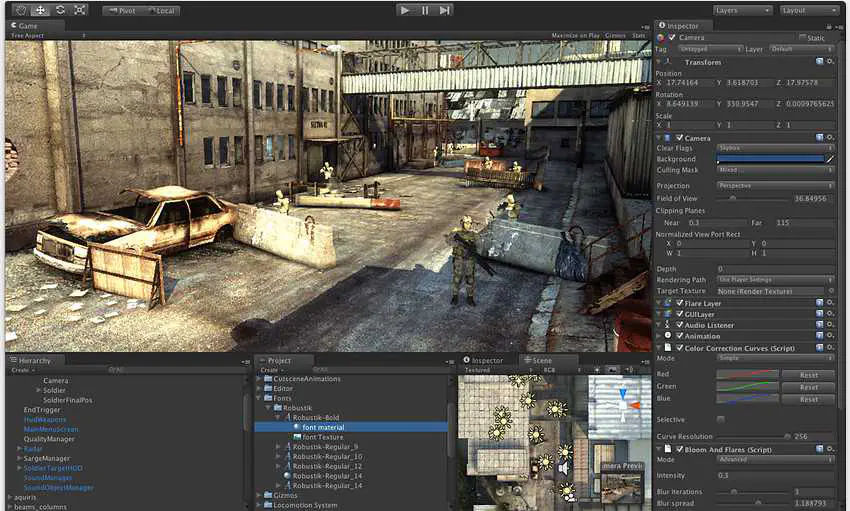
Started recently to play with Unity 3D, an IDE/Platform to develop games. I’ve heard about it because they recently decided that the indie version to be free. And because this version is quite similar to the Pro version and the Pro version is affordable, I decided to give it a try.

I am really impressed with the package. It is solid in features but what impressed me most is the easy user interface. Generally, programs that strive to be easy to use also make things too restrictive. Unity 3D is not one of them. It is a super intuitive IDE but also can be changed through code.

As I discussed before, the competition of engines should be irrelevant to game makers because we have a lot of data demonstrating that while the technology might help, the actual implementation is what matters. Good games with old/bad engines and Bad games with state-of-the-art engines are quite common.

The main reason to choose one is� current knowledge. Learning things all over again is costly, and Unity address this by adopting several standard technologies. For scripting, you can use C# (very close to Java and C++), JavaScript or Boo. For 3D models, it imports the most used formats (3DS, Max, Ma, Blender�). The same goes for 2D (which also includes importing Photoshop native files), sound and music. All that means that your workflow and suite of programs will remain basically the same.

With the indie version being free, a huge increase of documentation and community support is expected. The same for professional assistance. I’m happy to move from Torque (which uses several conceptual dogmas that I’ve never liked) to Unity.

PS: with the web player, its possible to create games for web pages just like Flash� take a look in the demos.

Unity 3d 3 content 2128.jpg
Unity 3d 3 content 2127.jpg
Unity 3d 3 content 2126.jpg
Unity 3d 3 content 2125.jpg

Settings API feature
2010.04.03

Settings API

After creating several sites using several CMSes, one single thing still annoys me: the lack of a proper export settings feature. Putting a local testing site in the official online server is always a nightmare, since we have basically try one of the options:

  • Copy the whole database: it also copies several testing data we used.
  • Step-by-step replication: After 3 days, you will still discovery several options that were not copied
  • Manually select DB table-by-table to copy: unless you really know of are you doing, its quite crazy

In Drupal world, one of my most admired companies, Development Seed, created both Features�and Strong Arm�that try to address this, but the lack of broad and ubiquitous support we still feel that we will miss something.

Settings API content 2095.jpg

There are 3 types of data that a computer program might have:

  • External: the spreadsheet for Excel, html to a browser, the image for Photoshop� its the reason why the program exists.
  • Internal: the data that makes the program works. It’s the settings.
  • Temporary: stuff that the program creates in order to gain performance. It, by definition, don’t need to be backed up because the program can recreate everything

Every program that is a platform should provide a Settings API. It would help on 4 big scenarios

Local / Production

There are several situations that we need to maintain a testing site for development new features without testing in the real production site. But time to time, we are satisfied with the test results and we and to apply the modification into the production site. For some business, like 3rd party site development, its the daily job, so its a must to make this workflow faster and painless.

Debug

After installing several plugins, its each to get a very unstable site, because they are changing same data. It would be much easier to monitor modifications and find solutions. A settings comparison tool would be great, so we could see what were overwritten.

Distribution / Template

Platforms, by definition, allow us to build stuff over it. But quite often projects are similar. So why not create a template for other people to use it? For a site builder like Drupal, we could create eCommerce, Blog, Forum templates for an easy deployment. It’s an extraordinary feature for newcomers.

Settings API content 2096.jpg

Stack

If the program is settings aware, a good extra feature is to apply in a stack. It’s a similar concept of CSS, cascading settings based on specific variables. Imagine, for example, a site about football teams. While the site has a main theme, each team’s page can have one and the users can have a personal one. We could enabled this cascaded settings for each setting.

Multidimensional settings

If we have different content types in a site (ex: static pages, forum pages and news pages), we could have a page to change all settings related to each content type and have a page to change a specific setting of all content types.

As we can see, settings is a very important part in a program. We have to think it with more care to leverage its potentials.

Data: storage, display and custom structure feature
2009.08.11

Data: storage, display and custom structure

Creating GUI is no easy task. But creating GUI creators is an even more complex task. Almost a nightmare. But the long road walked by GUI creation programs, we already know some things that are good and some things that are bad.

Drag and drop

Quite a long time, desktop IDE’s acknowledged that letting developers create GUI with some kind of drag and drop interface were critical. That were because GUI were less and less created by programmers but more and more by designers, that have little knowledge and patience to deal with programming code. It also facilitates the adoption by beginners.

Designer-driven script

A too designer/beginner driven interface for creating GUI might also not be a good choice. The whole customization and generalization possible by programming is lost. It’s too case-by-case development. It’s not cost-efficient. That’s why a middle term is needed. Some kind a language that is easy enough for designers but programmable. Drupal CMS uses the Form API, a PHP array that will be used to create HTML forms. It’s quite easy to be used by newbies. I heard that QT is preparing some custom language for creating their UI too.

UPDATE (2010-10-03): Qt revealed QML.

Data storage display and custom structure content 2100.jpg

“Lorem ipsum/123” preview

Most GUI element have a fixed set of parameters. But sometimes the GUI should be generated on the fly. Developing GUI like this is very trial-and-error. To facilitate the creating phase, its critical to be possible to see it working with some generic data.

Widget or data separation

The UI 101 rule is to separate the data to the layout. But it is important to let the users change any of them. For example, the user can enter his birth year by a text field or a dropdown list, or some nice JS calendar. This example show how to change the widget, the GUI element. However, the user might need to change the data type. If the birth year was originally text, the user might decide to change it to integer number. The challenge here is to convert saved data. But for most cases, it is feasible.

Data storage display and custom structure content 2102.jpg

Context

Developers of both desktop and internet applications are experiencing a quite interesting phenomenon: the same application must have several outputs, like netbook version or mobile sites. With the rise of HTML5, sites now might need multiple different outputs. Also, we must have different outputs when we are�creating, viewing�or update�content. The concept of multiple contexts might be anticipated by the GUI creators.

Custom data structures

Integers, float numbers, strings� all developers know these data types. But they know that in some cases it is needed a more complex data types; combination of primitives. Some programming languages have structures�and objects�to address this idea. But GUIs can also be the combination of multiple primitives. Imagine a “password_checker” GUI element that is, in fact, two form fields that will check if the user typed the password correctly or an “address” element that is, in fact, a group of *country, province and city* fields. Users might be enabled to create and edit these type of custom data structures.

UPDATE (2009-10-05): I just saw an issue posted against CCK module called State of the multigroup module. It has close relationship with this post. Curious is that it is more a hack than a core idea.

Woman filling out form, close up
Woman filling out form, close-up

2009.05.23

Query builder and Drupal Views

Views is the most popular module on Drupal. It’s not a coincidence: the ability to create custom lists on any Management System is critical. Views goes even beyond by creating a display API and enabling export some options to the end users.

I’m, in fact, really puzzled by the fact the Drupal next version, 7, does not integrate it into core. It IS a core module, by any perspective. Several administration pages should be designed as Views from the beginning and the whole DB schema data also should be redesigned to implement integration with that.

But I still see some features that Views could still implement.

The first is external data sources. Today we know that search huge amount of data is no easy task and Drupal core does it poorly. That’s why external programs like Solr, Sphinx are becoming more and more popular among Drupal masters. Views yet does a very little integration with those tools. The whole �8220;query builder" should redesigned to control other data sources. Ideally, it could search on any known data structure. By plugins, it would be possible to search external feeds directly, or some web services’ data, like Twitter, Flickr and Facebook without replicating the whole data locally.

I hope the newly created version 3 implements such abstraction.

Game Engines Virtual War feature
2009.01.21

Game Engines Virtual War

I simply don’t get the point when the game producers advertise the engine behind a game. Engine, for those are not familiar with, is the piece of software that deals the core functions in a game: 3D rendering, sound, network, etc. They usually say that their own home-made engine is capable of more graphics in the scene, with more details or more effects (mostly about the graphics power). But more than what?

Game engines virtual war content.jpg

Unless the company license their engines as core business, like Epic’s Unreal Technology, Valve’sSource�or id’s id Tech, there is absolutely no point on advertising it or even giving it a name but creating it some pseudo-credibility to the project.

Game engines virtual war content 0.jpg

WOW!! Mafia 2 are going to use�Illusion Engine! What the heck is Illusion Engine?

These pieces of software are complex to create. However, there was a lot of people that were capable to create one from scratch. Today, there are several of them, with different purposes (some are for hookies, some are for 3D pros or only for FPS games) and different quality (some are slow, some have incomplete documentation or lacking of tools). But there are enough that it might be considered almost as commodity.

Game engines virtual war content 1.jpg

Unreal Engine is, by far, the most popular among the big companies. Many bestsellers were created using its tools and libraries. But don’t even think about using it: it costs a fortune! So various companies had the same idea about position their owngame engines free. Some are worthy to mention: Garage Games’ Torque, Blender/Crystal Space and Radon Labs’ Nebula Device.

Some good games came from they: Torque is quite inexpensive, and it was used on the Penny Arcade Adventures; Nebula Device is completely free with the most permissive, the MIT license, and its behind Drakensang, which I’m going to play really soon.

Game engines virtual war content 3.jpg

Bruno MASSA