



Português English

Programming

A Study in Transparency: How Board Games Matter feature
2016.02.23

A Study in Transparency: How Board Games Matter

I just watched a GDC presentation by the same name by the developer Soren Johnson, from Mohawk Games. I’ve agreed almost entirely with him. The basic premise of his presentation is that video games should pay more attention to physical board games, learning that techniques they use in order to create engagement. The motif is: board games have transparent set of rules and transparent implementation of luck. Video games should have such transparency too to engage players.

At the end, when he opened for audience questions, he was nervous to answer and he somewhat backed a bit from this point of view. There were a couple of questions that I want to discuss:

What if the game system is so complex that you deliberately want to hide it from the player? (watch the original answer)

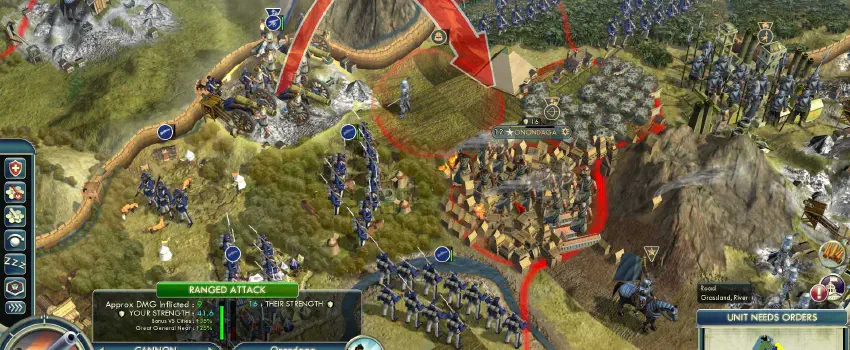
In Civilization, as pointed in the presentation, the designers opted for displaying each variable or modifier as a series of bullet points in the UI. That is because the list of modifiers is long and complex. When engaging in a diplomatic mission, the player must understand what are affecting the relationship. But hey, it is only one way to solve the problem.

In Shadow of Mordor, the orc leaders challenge themselves for power and status. Each orc also have a list of strengths and weaknesses. All this information is presented to the player is a very elegant way. It exemplifies the Soren’s argument.

But if game is so complex that is really difficult/impossible to present the players all information? Well, it is probably a flaw in the game. If there is too much going on, most likely that the player action only impact slightly in the result. The player will feel that is pure luck. He is just a passenger. It is the game designer’s job to balance it back; otherwise, it will suffer from bad reputation and bad sales. Too shallow or too complex have to be considered equally problems to deal.

Notice that another possible consequence is when the game becomes a cult hit and the players that endured the gameplay formed a community to share information and demystify the obscure rules. A good example is Dwarven Fortress, a super weird and complex game that is loved by many for being weird and complex. My suggestion: do not try this path.

If you expose the whole set of rules and internal numbers, it will become a matter of optimization instead experimentation. (watch the original answer)

It can be a problem, yes. Tic-Tac-Toe suffers exactly from this problem: you can anticipate the full match to a point that you CAN guarantee that you will never lose (you cannot guarantee that you will tough).

But as a designer, you can implement counter measures to fight it. Luck and complex decision tree for example.

Luck is the classic solution. By implementing a series of unknown events, it makes very difficult to predict the future. Random numbers, random events, scramble cards. Notice that luck is merely an element that the one cannot control or predict, like weather or a die roll, or a hidden enemy in a fog of war.

Complex decision tree refers to both make several factors relevant for each decision and a game with several rounds. Think of Chess or Go. There are so many possible movements per round that, while theoretically possible, it is practically impossible to compute all moves in order to make a single best decision.


In general, I am with Soren. I might discourse about it in the future, because most people think that creating games is just an intuition and art. But there a lot of reasoning and logical decisions that should guide the construction of such products.

My Experience with Angular JS feature
2016.01.22

My Experience with Angular JS

There are several months now that I started to program using the Google’s Angular JS libraries. For those that do not know it, it is a way to write web applications that are very interactive, interconnecting the user interface with JavaScript. Not simple to explain.

I tried jQuery long ago when developing for Drupal and for my personal enterprises, but I was very laborious to make it automatically respond to user interaction, in a passive (and always alert) way. Angular was just about to solve it.

Primarily, it was a pain to fully understand its concepts and methods. I spent weeks to write some prototypes. One of the major complains is debugging. It always logs cryptic messages, with full stack of weird functions and codes. I was never able to figure out what is the line of my code that is causing trouble or what is the function I wrote that is missing an important parameter, or whatever.

Angular parse and interpolates HMTL and JavaScript, in a dynamic way that it sometimes break before it can generate a nice error output. I have never played with its major competitors, React and Ember, but I honestly doubt that it is much different there.

Once I got better at it, I had a really good experience. I recommend you to use Angular JS and also Google’s Material Design Angular library in your own web app.

Microsoft opening source feature
2014.11.29

Microsoft opening source

Microsoft announced that they will make Visual Studio available for free for everyone, for every type of application. Paid versions would bring essentially better support, ideal for enterprises.

They are also tightening more and more to the open source world. They started to use GitHub (instead their own hosting service and version control systems), made public available general use programs, libraries and APIs. The JavaScript successor, TypeScript, is an internal creation. An open source C# compiler, Roslyn, is in the works.

Times are changing.

I believe they realized that Google and other vendor are gaining more and more traction by using an open approach. Giving people pieces that free and charge for premium services. The mass of new developers are now programming for web applications, with tools and environments that Microsoft products are not in a strong position. Everybody will win. They maintained the leadership in several software markets not by accident or luck. Their experience will benefit all the community.

Welcome aboard.

Image 4.png

Edited: the original article was found at http://blogs.msdn.com/b/somasegar/archive12/opening-up-visual-studio-and-net-to-every-developer-any-application-net-server-core-open-source-and-cross-platform-visual-studio-community-2013-and-preview-of-visual-studio-2015-and-net-2015.aspx

2014.06.10

Ping

I’m not dead. Neither is the blog. I’m going to —poorly- explain why.

I’m just very focused on other projects, like my own new company Gamenific. It is, for now, an informal company, but I am investing more and more time and money, and energy into it. The Gamenific blog, that I write, is getting much more updated than this one.

My main day job is also requiring loads of time. Especially at the beginning of the year, when I was responsible for implementing an Online Booking tool in the company, was very demanding. I was working 16 hours a day. No social life was allowed. I cannot stress enough that it is very counterproductive: working that much for long periods is very tiring. Tired minds do not think properly and make constantly wrong decisions. One after the other.

But now things are normal again.

World Cup is here. It will officially start this Thursday and Rio de Janeiro, one of the hosting cities, is upside down. The transport is the worst, not only it is operating at overcapacity, but also the worker unions are taking the advantage of the situation to start constant strikes to raise salaries. The population is a hostage.

Back to Gamenific:

My plan is to make this company my life. If all goes right, it will become my main source of income in the next year, maybe two. And at this point, I plan to make it a full-day job.

Being a one-man company is not easy. By far. The amount of work that it takes is enormous. Secondary administrative tasks, like blogging, contacting new contractors, marketing, and making strategic plans… are very demanding. I wish I have someone to share the burden. But I am not complaining. On the contrary, it is very fun. Is hard and I love it.

I will keep Gamenific news in the Gamenific blog as much as possible, keeping this blog more as a personal view, especially related to programming, video games, and cinema. Eventually, I address some political or economical matters.

In Brazil, national elections are coming. I think it will be the subject of some texts in the near future.

Ludum Dare 29 – Vaults Inc feature
2014.04.29

Ludum Dare 29 – Vaults Inc

Ludum Dare! The famous indie game competition has just ended and I once again locked me out of the world for 3 days to design, program,

In this edition, the theme was “Beneath the Surface”. In comparison with other editions, a very easy theme because it defines only the thematic aspect of the game. Most of games can be adapted to fit the theme, from shooters, strategy games, platformers. It is much harder when it restricts the mechanics of the game, like “10 Seconds” from Ludum Dare 27.

In my case, even with an easy theme, I face a lot of difficulty to design the game. I know that Ludum Dare audience is mainly indie designers with very little experience and they appreciate mostly popular action game genres, like platformer, top-down adventures and first-person shooters. But it was definitively not what I wanted in this edition. With an easy theme, I wanted to innovate in the mechanics.

In Brazil, the competition started Friday by 10pm. It is generally a good thing, because we are tired from work and it is close to sleeping time. Because the openness we got from the theme, I faced a lot of difficulty on designing, because designing requires restricting yourself. I only closed the final mechanics by Saturday lunch, 12 hours after the competition start.

Vaults inc 1.jpg

Vaults Inc

Vaults Inc is a turn based strategy game. It is like a city building, but underground: you build a bunker from a post-nuclear-war universe. Imagine Fallout’s vaults. I wanted to grab a little of its universe, especially the visuals and humor.

Each turn the player have to build a new block in the bunker. Each block can increase or decrease or Income, Money, Fame or Population. The strategy comes from the interaction that each new block generates: Landfill decreases Fame is placed next to a residential block; slaughterhouse generates more income if placed next to a restaurant; fancy restaurant decreases fame is other fancy restaurants are built. Timing and Location are crucial.

Bigger bunkers means bigger problems: the more you grow, your fame and income start to go down. The game has typically 50 turns and the player have to reach the biggest population possible.“The most complete Fallout-Bunker-Simulator. Learn it for a future not that improbable”

Play it online for free (EDIT 2021: not available anymore)

Vaults inc 2.jpg

Vaults inc 3.jpg

The post was originally on blog.Gamenific.com

Bruno MASSA